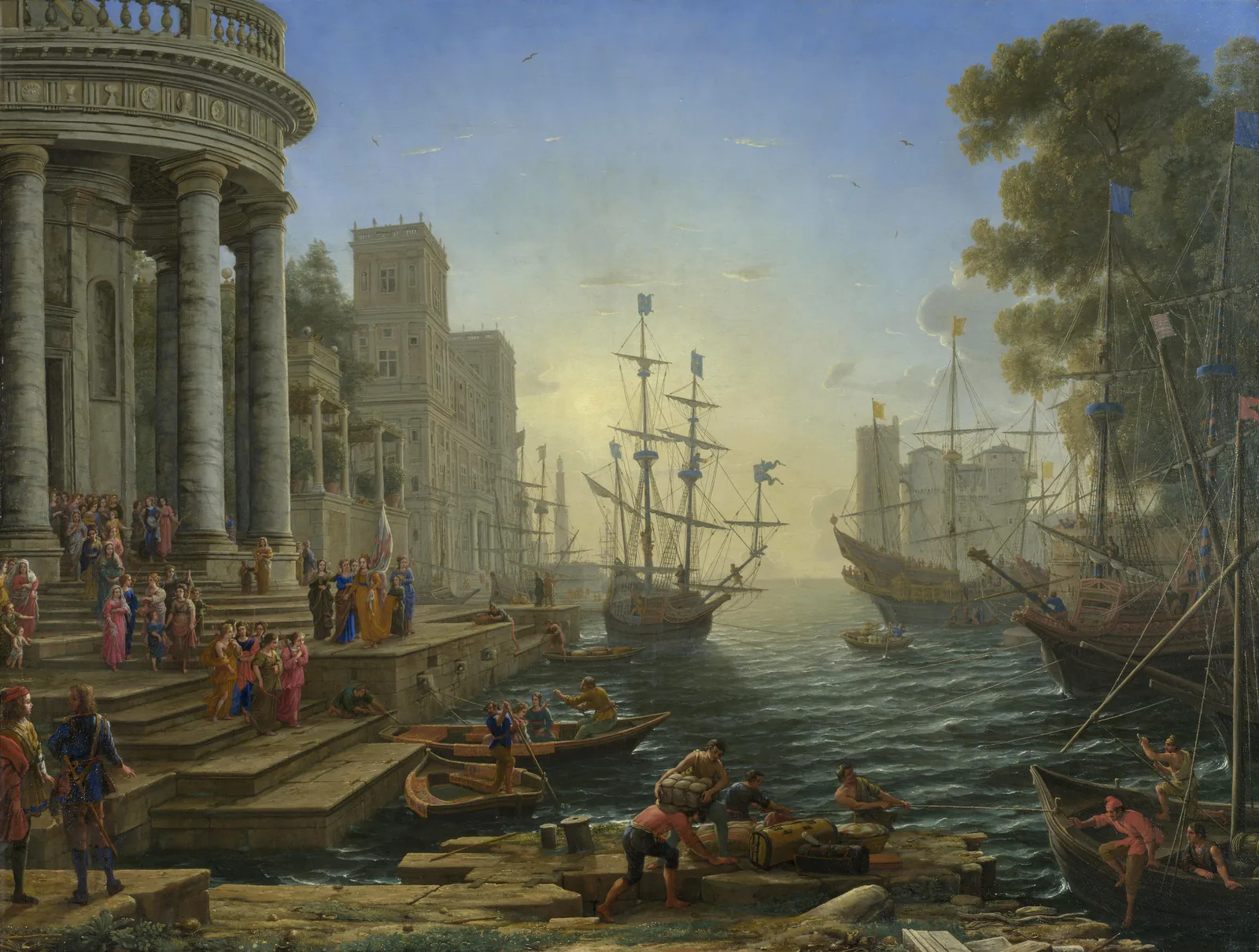
The harbour of Claude’s painting in the National Gallery, London, built so that it can be seen from where he stood and then walked: a round Doric temple on its steps, a palace with its tower and hanging garden running down the quay to the setting sun, a galleon in the middle of the harbour, ships and boats, a lighthouse, a fortress.
Saint Ursula, a British princess, set out for Rome with eleven thousand maidens and was martyred with them by the Huns at Cologne on the way back. Claude shows her setting out: she stands at the head of her maidens on the quay, holding her banner, while the boats load their baggage for the galleon waiting in the harbour.
The painting was made in 1641 for Fausto Poli, a cardinal in the household of Urban VIII, and came to the National Gallery with the Angerstein collection in 1824, one of the Gallery’s founding pictures.
The scene is lit from the sun low over the sea at the end of the harbour, behind the galleon’s rigging, so that every building faces the viewer in shadow and its outline stands against the haze. Claude painted the sun itself, or its glare, in picture after picture; it is the light of his seaports.