Part III · Chapter 12
Claude’s Seaports
The ideal harbour of Claude Lorrain, built from his paintings
Claude Gellée, called Claude Lorrain after the duchy where he was born at the beginning of the seventeenth century, came to Rome young, trained with the landscape and fresco painter Agostino Tassi, and lived there until his death in 1682. He painted for Urban VIII and his cardinals, for Philip IV of Spain and for the princes of Rome, and became the most sought-after landscape painter in Europe. Between about 1636 and 1648 he painted a series of harbours: classical buildings on quays at the water’s edge, ships of his own day riding at anchor, porters loading boats, and a story from the Bible, from Virgil or from the lives of the saints being acted out in the foreground, all under a low sun.
None of these ports existed. Claude made them up from studies of Rome and the coast near it, of real buildings and of ruins, and they became the picture of what a classical city by the sea should look like. In the figure below, one of them is built. The painting is drawn first; when the model is started it is drawn over the painting from the place where the painter stood, and the line between them can be dragged across, the one faded into the other, or the camera let go to look round the scene or to walk on its quay.
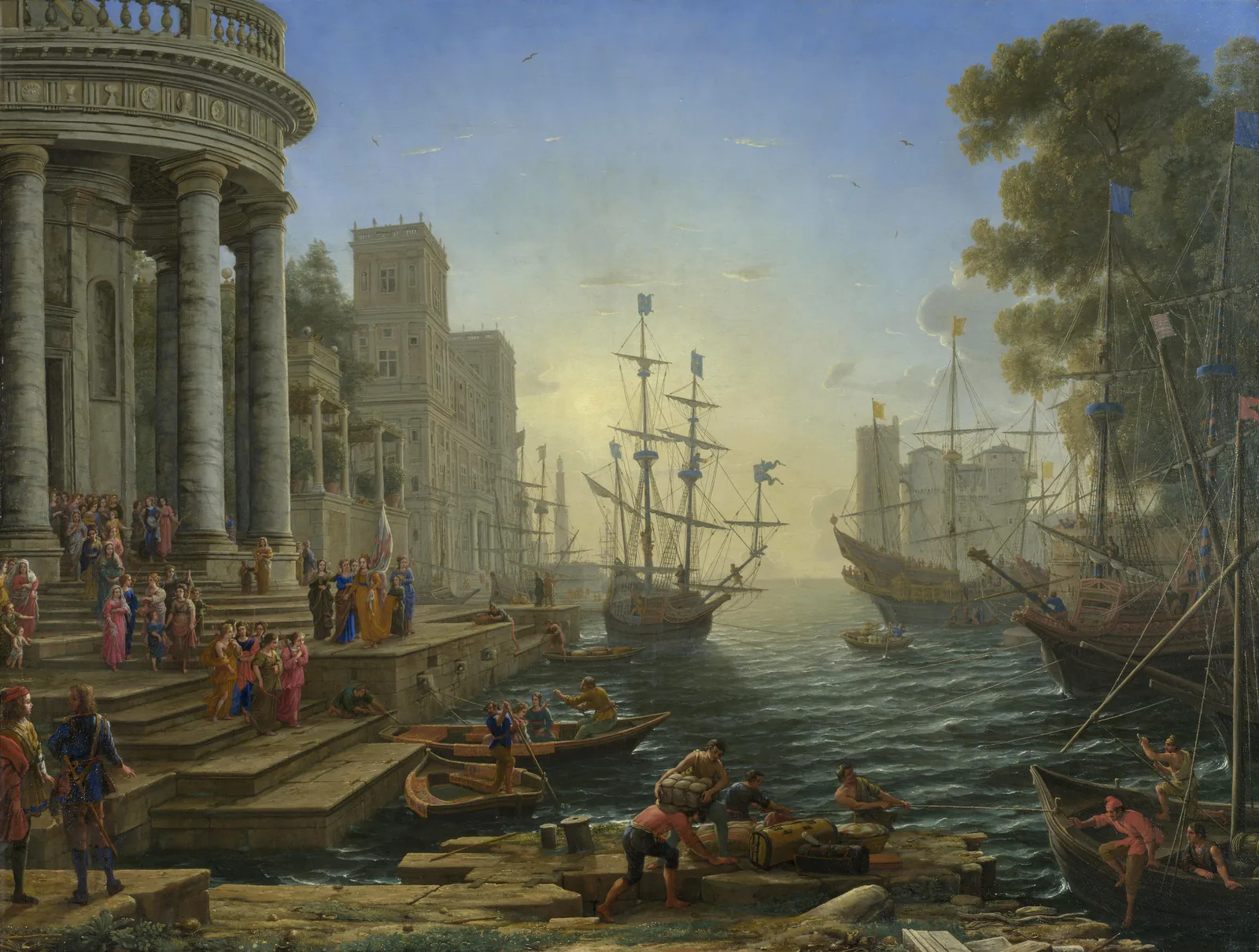
Saint Ursula’s harbour
Saint Ursula was a British princess who set out on pilgrimage to Rome with eleven thousand maidens and was martyred with them by the Huns at Cologne on the way home. Claude shows her setting out. She stands at the head of her maidens on a broad landing, in yellow, holding her banner, while they come down the steps of a temple behind her and boats are loaded with their baggage for the galleon waiting in the harbour. The picture was painted in 1641 for Fausto Poli, a cardinal of Urban VIII’s household, and it came to the National Gallery in London with the Angerstein collection in 1824, among the Gallery’s first pictures.
On the left stands a round temple of unfluted Doric columns, its frieze of triglyphs and rosettes and its balustrade cut off by the top of the frame. It is very like Bramante’s Tempietto in Rome (Bramante’s Tempietto), made almost three times as large. Beyond it a palace runs down the quay toward the sun, four storeys high, with pilasters between its windows and statues on its balustrade, a square tower at its near corner and a hanging garden in front of it, with a pergola and orange trees in pots. At the end of the harbour is a lighthouse; across the water a round fortress tower; on the right, ships moored under a clump of tall trees. In the foreground porters carry bales across a landing of broken slabs to the boats.
The model was built by measuring the picture. The horizon lies 0.607 of its height from the top, and the lines of the palace, the quay and the ships meet on it at a point 0.54 of its width across: this is the centre of vision, where the painter’s line of sight met the picture. The figures give the scale: a woman of 1.8 m on the landing is 0.08 of the picture’s height, which puts Saint Ursula 38 m from the painter and his eye 1.3 m above the landing she stands on, or 3.3 m above the water. With the eye taken to stand 1.7 times the picture’s height away from it (a field of view of 42.5° across its width), every point in the picture then has a place: the temple’s nearest columns 45 m away, the galleon 119 m, the tower at the corner of the palace 165 m, the fortress 260 m.
Set the horizon a little below the middle of the picture, about two-fifths of the way up; let the lines of the buildings and the quays run to one point on it near the middle; and put the sun, or its glare, low in the sky over that point, so that the light comes toward the viewer and every building stands against it.
horizon ≈ 0.6 of the height from the top; sun 1°–7° above it
Close the picture at one side, or at both, with a dark mass near at hand (a building, a ruin, a clump of trees or a ship), as the painted wings of a stage close its scene; set a feature in the middle distance; and open the centre on a bright distance across water.
Claude did not draw with one fixed eye, and the model cannot match the picture everywhere. The temple is drawn as if from nearer than the harbour behind it: its three nearest columns are placed as if on a ring about seven metres across, too small for sixteen columns of their size. The figures are a little large for the buildings, and the ships a little small for the figures. The model keeps the main lines of the picture (the horizon, the edge of the quay, the tops and feet of the columns, the outlines against the sky) and gives every building the size its figures suggest. Where the two disagree, the picture is the better guide to Claude, and the model to what such a harbour would have been.
How a seaport was made
Claude wrote nothing about his art, and his rules have to be read from his pictures and from the people who knew him. The painter Joachim von Sandrart, who sketched beside him at Tivoli in the 1630s, describes how he studied: in the open air, from before dawn until night, to learn the colours of every hour of the day, mixing his colours in front of the scene and taking them home to the picture (Study the light out of doors, at every hour). Over the whole series the light is always a low sun, early or late, standing over the sea at the end of the view; it is the subject of the seaports as much as any saint or queen.
Study the sky in the open air from before dawn until night, to learn the colours of sunrise, sunset and twilight; mix the colours there, in front of the scene, and carry them back to the picture in the studio.
The composition was built up in planes, like the scenery of a stage. A dark mass at one side, or both, closes the view: a building cut off by the frame, a ruin, a clump of trees or a ship. A feature stands in the middle distance, and between the wings the view opens on bright water and the sky. The horizon is low, the eye level and the verticals upright, so that the buildings are seen as a man standing on the quay would see them. On eight of the pictures, measured for this book on photographs of the paintings, the proportions hardly vary:
| Painting | Date | Horizon, from the top | Centre of vision, from the left | The sun |
|---|---|---|---|---|
| View of a Port with the Capitol (Louvre) | 1636 | 0.607 | 0.41 | a bright haze, 7° up, 6° left |
| The Campo Vaccino, Rome (Louvre) | 1636 | 0.61 | 0.47 | none; soft daylight |
| Port Scene with the Villa Medici (Uffizi) | 1637 | 0.665 | 0.49 | a disc, 1° up, 10° left |
| Seaport at Sunset (Louvre) | 1639 | 0.623 | 0.60 | a disc, 2° up, 3° right |
| Seaport with the Embarkation of Saint Ursula (National Gallery) | 1641 | 0.607 | 0.54 | a glare, 6° up, 3° left |
| The Landing of Cleopatra at Tarsus (Louvre) | 1642–43 | 0.635 | 0.62 | a veiled sun, 5° up, 10° left |
| Seaport with the Embarkation of the Queen of Sheba (National Gallery) | 1648 | 0.585 | 0.50 | a disc, 3° up, 3° left |
| Coast View of Delos with Aeneas (National Gallery) | 1672 | 0.568 | 0.50 | a glow on the horizon, 20° left |
Reynolds, lecturing to the students of the Royal Academy in 1771, put Claude’s method in a sentence: he was convinced that nature as he found it seldom produced beauty, and his pictures are compositions of the studies he had made of many beautiful places (Compose, do not copy). Claude kept a record of the result. From the late 1630s, when copies of his pictures were already being sold in Rome under his name, he drew each painting before it left his studio in a book, the Liber Veritatis, noting on the back whom it was for. Its drawings, engraved by Richard Earlom in the 1770s, carried his compositions all over Europe.
Do not paint one place as it is: compose the picture from studies of many places, taking from each what is beautiful, so that the whole is a place that never existed but might have.
Borrowed buildings
The buildings of the seaports are the buildings of Claude’s Rome, moved to the sea. The garden front of the Villa Medici on the Pincio, below which he lived, near Trinità dei Monti, stands on a quay in the Port Scene with the Villa Medici (1637) and again in the Seaport at Sunset (1639). Michelangelo’s Capitol, the Palazzo Senatorio with its tower and the giant order of the Palazzo dei Conservatori, is set on a harbour in a picture of 1636. A temple like the Pantheon, a portico of eight Corinthian columns before a domed rotunda, stands on the island of Delos in a picture of 1672. Round temples recur, Doric or Corinthian, sometimes with a dome, after the Tempietto and the Temple of the Sibyl at Tivoli; and the Arch of Titus stands on the quay of A Seaport of 1644.
His palaces are imaginary, and are put together from the palaces of the cardinals and princes he painted for: a rusticated ground storey, framed windows between pilasters, a balustrade with statues against the sky, a belvedere tower. In the model they are built with the book’s own generators, from the rules of the palaces they imitate: the palazzo block with its rustication and crowning cornice (A palazzo block), a square tower with statues in niches (A belvedere tower), a garden raised on a high wall (A hanging garden).
The ships
The ships are not ancient. They are the merchantmen and galleons of Claude’s own day, painted with care: deep hulls that narrow toward the deck, high sterns of carved and gilded galleries and windows with three lanterns over them, a beakhead under the bowsprit, three masts each with its round top, topmast and yards, the sails furled, flags and long pennants at the mastheads. They are the same in every harbour, whether the story is Ursula’s, Cleopatra’s or the Queen of Sheba’s, and one generator builds them all.
Claude in England
In the eighteenth century the English bought Claude more eagerly than anyone. John Julius Angerstein owned Saint Ursula and the Queen of Sheba, and they were among the pictures bought for the nation to found the National Gallery in 1824. Turner left his Dido building Carthage, painted in rivalry with the Queen of Sheba, to the Gallery on condition that it hang beside it.
Claude also taught the English to make landscapes out of real ground. William Kent, who had studied painting in Rome, composed the gardens of Chiswick, Stowe and Rousham as Claude composed a picture, with clumps of trees for wings and temples seen across water (The garden as a picture; see Gardens and Landscape). At Stourhead in Wiltshire, from 1741, the banker Henry Hoare dammed a valley into a lake and set round it a Pantheon by Henry Flitcroft (1753–54), a Temple of Flora and a Temple of Apollo, to be seen across the water from the walk round it, as a domed temple stands across a valley in Claude’s Landscape with the Temple of Apollo, of which a full-size copy is at Stourhead. Travellers carried a Claude glass, a small dark convex mirror, to see real scenery reduced and toned like a Claude; and Gilpin, Price and Knight argued about how far a landscape should be improved to look like one (Price’s Essay on the Picturesque).
What the model is
Cite this page Chris Paton, “Claude’s Seaports”, The Textbook of Architecture, https://textbookofarchitecture.com/chapter/claude-seaports. Text, drawings and models licensed under CC BY-NC 4.0.