Light the climax of a Baroque interior (the altar or the dome) from windows the visitor cannot see, so that it seems to glow of itself.
Study the light out of doors, at every hour
Study the sky in the open air from before dawn until night, to learn the colours of sunrise, sunset and twilight; mix the colours there, in front of the scene, and carry them back to the picture in the studio.
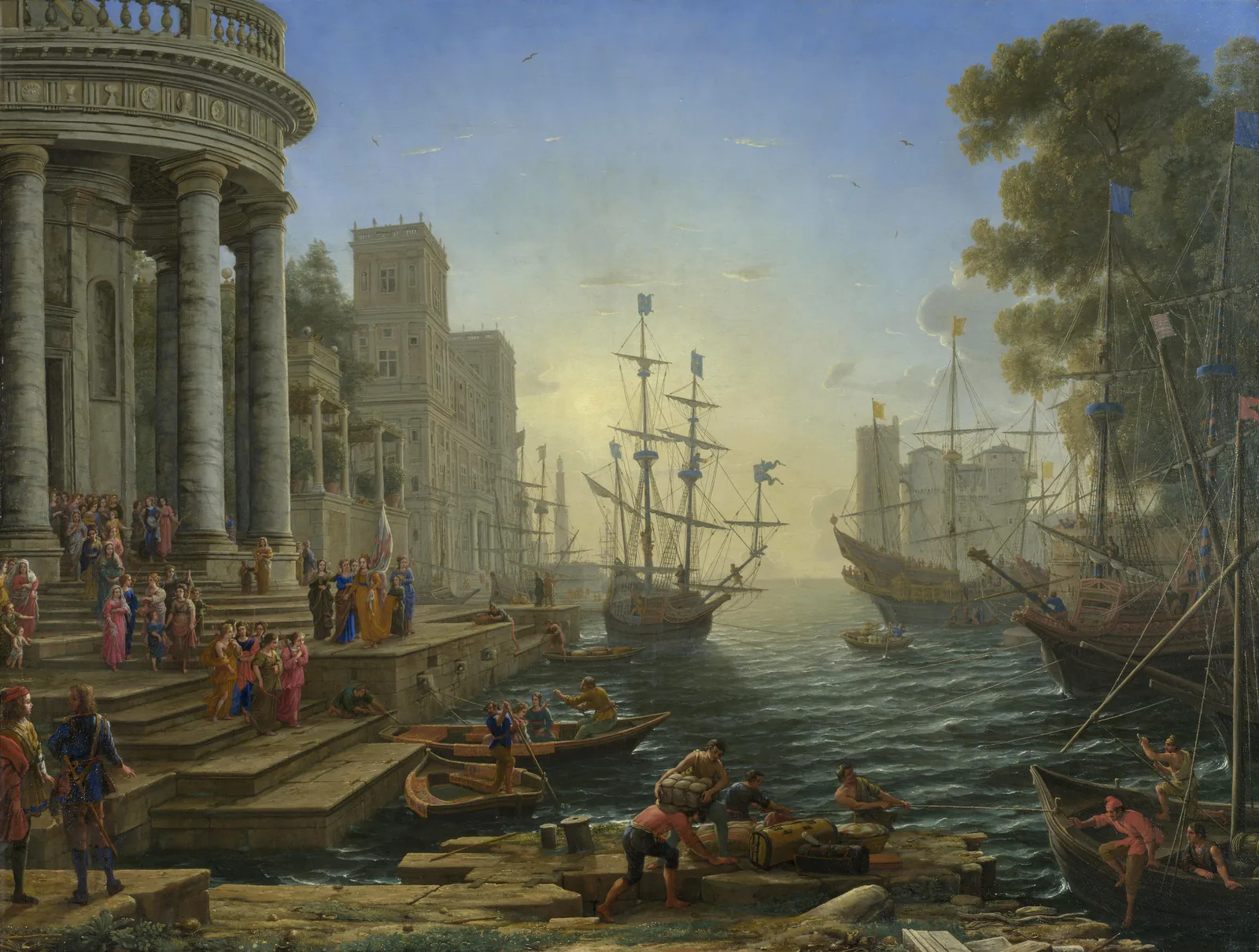
Sandrart, who painted beside him at Tivoli, wrote that Claude “used to linger in the open air from before daybreak even to nightfall, so that he might learn to depict with a scrupulous adherence to nature’s model the changing phases of dawn, the rising and setting sun, as well as the hours of twilight. When he had in this manner well considered his subject in the open air, he forthwith mixed his colours according to the tints before him, and then returning home, applied them to the work which he had in hand, with greater truth than any one had done before him.”
The seaports are the result: each is lit by a sun at a particular height, early or late, and each has the colour of that hour. The model of Saint Ursula is lit the same way, by a sun 6° above the sea and 3° to the left of the centre of vision, in a haze that takes on its colour toward it.
Related rules
Hold that the beauty of the orders comes from fixed proportions that please by nature, as consonances do in music; where the ancients differ, the differences answer to circumstances such as distance and height.
Avoid the ornaments that have no model in the hut: broken or curved pediments, pediments on the long side of a roof, orders piled storey upon storey on a church front, arches carried on columns, and twisted or cabled shafts.
Distinguish positive beauty, which pleases everyone for evident reasons (fine materials, size, precise workmanship, symmetry), from arbitrary beauty, which pleases through custom, including the exact proportions of the orders.
Set the horizon a little below the middle of the picture, about two-fifths of the way up; let the lines of the buildings and the quays run to one point on it near the middle; and put the sun, or its glare, low in the sky over that point, so that the light comes toward the viewer and every building stands against it.
horizon ≈ 0.6 of the height from the top; sun 1°–7° above it
Close the picture at one side, or at both, with a dark mass near at hand (a building, a ruin, a clump of trees or a ship), as the painted wings of a stage close its scene; set a feature in the middle distance; and open the centre on a bright distance across water.
Cite this page Chris Paton, “Study the light out of doors, at every hour”, The Textbook of Architecture, https://textbookofarchitecture.com/rule/claude-study-of-light. Text, drawings and models licensed under CC BY-NC 4.0.